

Remote Texture Sharing
Textures can be shared between Designer and Unreal Engine.
The RenderStream Unreal Engine plugin offers support for the sharing of textures remotely through the use of exposed parameters. This allows a two-way flow of video content between Designer and the Unreal Engine.
Remote Texture Sharing
Section titled “Remote Texture Sharing”Create a new material
Section titled “Create a new material”In this example, we will use a Plane to demonstrate remote texture sharing. But you can use any object.
- Add a Plane (or other 3D object) to the scene.
- Right-click inside the Content Browser and select Materials & Textures > Render Target to create a new Render Target.
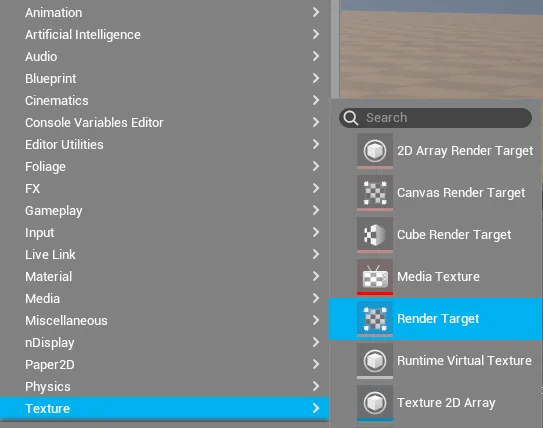
- Assign the Render Target Texture as a texture of the material on the plane.
- Confirm that the new Material has been created and set as a material element in the Materials component of your object in the Details panel.
Expose the Remote Texture as a remote parameter
Section titled “Expose the Remote Texture as a remote parameter”- Open the RenderStream Blueprint placed in your level (RenderStream 3.0), or the Level Blueprint (RenderStream 2.0 and earlier). See Exposed Parameters in Unreal Engine to create a RenderStream Blueprint.
- Click the Add button next to Variables and name the variable according to the desired property (e.g. Render Texture) and compile the Blueprint.
- Select the variable and set the Variable Type in the Details panel to Texture Render Target 2D.
- Enable Instance Editable.
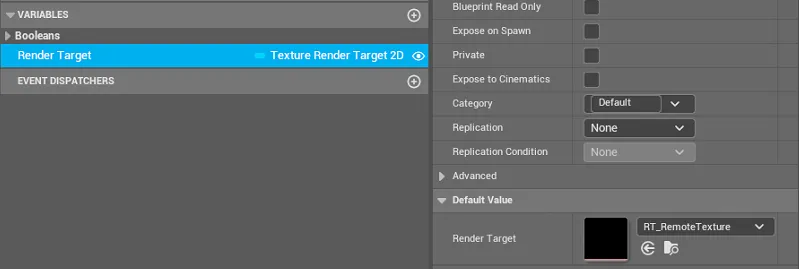
- Set Category to the name of the menu you wish the parameter to appear under in the RenderStream Layer.
- Compile and save the Blueprint.
- Select the RenderStream Blueprint actor in the level and set the variable to the Render Target you created earlier.
Colour-managed texture parameters
Section titled “Colour-managed texture parameters”With the RenderStream 3.0 plugin and Designer r34.0.2 or later, texture parameters are colour-managed when OpenColorIO (OCIO) is enabled in the RenderStream plugin settings. Textures sent from Designer, including HDR content, are converted into the Unreal Engine working colour space, so they match the colour and brightness seen in Designer. This works with both compressed and uncompressed RenderStream streams.
For setup steps, see Unreal OCIO Setup.
© 2026 Disguise